I have been asked by several people to provide a turn-key kit for rally. I only want to make enough to cover the cost of my time and shipping. I provided all the links to various items – there are no doubt other ways to build one of these – but I feel this would be your best bet. If you have the ability, I encourage you to go out on your own or modify what I have here. Seeing 10+ cars at a rally with APRS beacons on a big screen in service is my goal. Following the action of a US national level rally from the internet would be cool too.
You only have a short time left to sign up for the 2008 CRS Rally School in Ridgecrest, CA. This year’s class will be held on February 9th & 10th (Ridgecrest rallycross will be held on Sunday). A new element will be added this year for those just getting into rallycross. If you are at all interested in Rally, you’ll learn exactly what you’ll need to get started. Driver, Co-Driver, Rallycrosser, Volunteer, Spectator – the time controls and techniques will all be covered. From those who just finished building a car to those considering trying a rallycross – you’ll get so much out of this class!
We’ll be out there again this year to instruct and support this great program. Christine will help with the co-driver class, notes calling, etc. I will be covering the car prep section as well as instruction out on the driving course. We should have the Rally Neon out there.
Blind Rally: Rallies in the US evolved a little differently then rally in Europe. Starting out as all night TSD’s (time speed distance) or brisk rallies, rally in the US did not typically run reconnaissance. This means that the rallymaster would give the co-driver a route book with major navigation instructions and some of the more extreme things to watch out for. Example: “BRIDGE – TURN RIGHT ON SNAPPY ROAD – CAUTION HAIRPIN” Next to this would be a little diagram (on right) showing the direction of the road or obstacle. Sometimes called ‘tulips’, the name is believed to come from the Tulip Rally of the Netherlands that originally used them.
European rallies were also blind without recce’ for many, many years. It is believed that reconnaissance started some time in the 70s. The RAC remained blind for many years after all other rallies allowed recce’. European rallies started with the Monte Carlo in 1911 as an advertising gimmick to get rich people, i.e. those that owned cars to come together or rally, in Monte Carlo and stay in hotel rooms that were vacant in February. The object was to start from different cities across the continent and maintain a given speed while going to Monte Carlo. As cars became more capable, the speeds got too high to be safe and special stages had to be developed. In the 1970’s US rallies started to offer Special Stages and soon a distinction was made between Time Speed Distance rallies and Performance rallies. Rallies without reconnaissance are considered “blind”.
Route Book: The route book was the standard that the US had been rallying with for many years. The route book tells you about obstacles, cautions, difficult or deceptive turns, and how to get there. As created by the rally master of the rally, route books often vary wildly from rally to rally. Some rally masters choose to include as much information as possible, some find it more challenging to include as little as possible. Cautions and turns are often marked differently as well. A double caution (!!) in one rally may mean something like “slow down for this,” whereas at another rally it may mean “brake hard and watch out as you will destroy your car.” With a route book the co-driver is not calling every turn, so there is a lot of times where the driver is driving it how he sees it. As in – driving it blind. You will always receive a route book of some type when you compete in a rally, even if it’s just transit directions, often bound in the same physical ‘book’.
Stage Notes: Stage notes are generally accepted as “notes made by a computer” and rallies in the US would not see stage notes until the 21st century. A company in Sweden called Jemba (owned by Arne Johansson) had perfected a system that would allow a car with a very accurate odometer (coralba tripmeter), laptop, GPS, and accelerometer (measures G-Force) to generate detailed “European style” notes, marking every corner, crest and obstacle on the route with numerical or descriptive notations. Example: “! R3/Cr/rox into smCr 50″ In order to do this you would have to run the car with the system down the stages several times at a steady pace. There is still some human intervention needed to mark exposures, large obstacles, cautions, bridges, etc.
Stage notes (sometimes called Jemba notes) attempt to call out every corner on the stage and give details as to the roads direction, camber and character. It does not however tell you how to drive those corners. For example: “L5> R5 kinks 70″ describes a road that has a slight chicane. If the road is wide enough a rally driver should attempt to run straight through them and avoid turning (slowing down) as much as possible. The subtle difference between how the road is described and how you would drive it, separates stage notes from pace notes. Even so, once rallies began using stage notes, their stage records were shattered by drivers taking full advantage of this new system. Stage notes are often an additional financial burden to the organizers. P-Sport (owned by Pete Lahm) is the only organization known to offer Jemba stage notes in the US. Rally America currently specifies in their rule book that only one vendor will be used for their national championship’s season stage notes. Regional events may utilize organizer supplied notes.
Understanding Co-Drivers for Noobs
Gibeault Notes: In 2007 Kristopher Marciniak suggested to Michel Hoche-Mong (Engineer / Rally Driver / Organizer) that with off-the-shelf technology a new stage notes making system could be derived. After days of tinkering with accelerometers, GPS, and video – the idea was pitched to Mike Gibeault (Seriously smart engineer / California Rally Series / Rallydata.com). Mike suggested that getting data from just the steering wheel, in a car driven in the middle of the road at a steady speed, coupled with mileage and other data sources – you could get very accurate stage notes. Two rallies were first mapped by Mike & Paula Gibeault; North Nevada in 2008 and High Desert Trails in 2009. With these first successful tests the process was refined further with input from national winning co-drivers and drivers. Chrissie Beavis added the critical element of national level co-driving experience that was instrumental in developing the details of the algorithms as well as determining how to compress the computer data (which in raw form has too much information) down to what is salient for a given sequence. It wasn’t long before organizers in the Southwest switched to Gibeault Stage Notes for a quarter of the cost with equal (or better) consistency. In 2011 The High Desert Trails AND The Prescott Rally both ran Gibeault Stage Notes with no reconnaissance – a true test of a blind rally with organizer supplied stage notes.
By comparison, Gibeault Stage Notes are quite similar to Jemba in the degree of turn, distance, and description. It is very easy to use them if you’ve ever driven with Jemba notes. Where as the development of Jemba seems to have stalled out, Gibeault Notes continue to crystallize and sharpen complex sequences of corners with better algorithms, better descriptions, and an updated glossary.
As a competitor, you are usually not required by the rally to have (purchase) stage notes. They are generally included in the cost of entry or offered for an additional cost between $100 – $175 with the understanding that anything wrong in the stage notes is solely your problem. Rally America finally dropped its limitations on new drivers and co-drivers from purchasing stage notes. NASA Rally Sport has had no limitations on stage note providers or new driver stage note restrictions.
Pacenotes: Pace notes are created during reconnaissance (recce`). Reconnaissance is what most European and all WRC drivers and co-drivers use to create notes, specifically pacenotes. Unlike Jemba, there is no set standard between teams. Some prefer calling the direction of the turn after the tightness, some use a descriptive method – there are many styles. It is solely up to a driver and co-driver to determine what works for them. The team drive the road several times and notate each corner, obstacle, caution, and mark down (what they perceive to be) the fastest way through the stage. Here in the US, reconnaissance is sometimes offered along with stage notes as a way to further sharpen the notes into something you would drive and not just a description of the road. There is a significant inherent cost to teams running a full reconnaissance that include additional days off, hotel, gas, and other travel expenses.
Combinations of notes: Several combinations have been offered in the last few years by rally organizers in the US. Route Book with the option to buy Stage Notes has been the most common after 2002, but Route Book ONLY was the standard for 30+ years. Reconnaissance has been offered with stage notes and a shorter format called “One Pass Recce`” where you must have purchased the stage notes, and you will only make one recce` pass down each stage. This lightens some of the burdens of running a full reconnaissance. Reconnaissance has been offered instead of stage notes because of the high cost incurred by the organizer. This is due in part by the decline in rally participation (less entries to pay for it), and the increasing cost of the stage notes from a single vendor. Organizer supplied notes have been tried with some controversy. These are notes made by a professional driver or co-driver (not a computer or algorithmic method) that are then printed up and offered to the competitors. This isn’t always successful – as in Olympus 2006.
EDITORIAL – By Kristopher Marciniak
The Nintendo Generation: The internet allowed media and games from WRC and European rallies to flow into the US in the late 1990’s. I myself was following WRC long before I even knew there was an SCCA rally 100 miles from my home in New Hampshire. The images and ideas of rally – specifically the co-drivers rattling off hundreds of instructions while the daring drivers made heroic efforts to shave micro-seconds off their stage times – were forever burned into our brain. Anything less then this amazing driver and co-driver interaction wasn’t going to cut it. This may help to explain why competitors that have been competing in rally in the US for many years don’t understand why newer competitors demand stage notes and recce`. Remember the SCCA didn’t start using stage notes until 2002.
Where do we go from here? 2013 Cost continues to dictate what rallies offer. Accurate and consistent stage notes from suppliers like the Gibeaults are making it once again affordable. Some rallies are still seeing less then 20 competitors and thus dropping stage notes. This makes a lot of competitors stay away and reduces the event to an unsustainable amount of entries. “Reconnaissance only” in some cases is cheaper then the cost of notes for the organizer and has shown to bring out the competitors that would normally run stage notes. Unfortunately the inherent cost of recce` to the competitors is a lot higher then $100 – $175 stage notes, so this is also not an ideal situation. Going back to running route book only is not even an option any more. I believe that small regional events do not require recce` to be successful. I think that a balance of events that have stage notes with and without recce` should continue.
Good news, bad news. Somehow we must have installed the axle wrong. When we popped it out, or jammed it in (in 6 seconds). I think that maybe one of the bearings popped out of the hub side. The axle rolled forward and without a bearing in there, it crunched up the ‘end bits’.
I know this because Harry and Dan stopped by the shop and we installed a back-up axle. Everything seemed to turn nicely and I took Ze’Neon down the street for a quick ‘is the tranny blowed up?’ test. 1st through 5th – all working! I even did a tire chirp-burnout to stress the axle. If it’s going to break, I want it 50 feet from the shop. So I zip down the street one more time and whip the car around. Wide open throttle in first and then the car falls on its face. “Uh oh…” I mumble. Some sort of fuel starvation from the tight corner probably. I have a half tank of gas though… The power picks up and I make it back to the shop. Then it stumbles again. Seems like a fuel issue and probably why it’s been hard to start it.
I hot-wire the fuel pump and we took the remaining fuel out of the gas tank and into a container. It’s coming out of the hose for the fuel rail very weak. Sorta like a foam soap dispenser. The gas is all frothy and the flow can’t be right. It may be the lack of pressure, but the Neon doesn’t use a return line in the engine. The fuel is looped and cycled through the filter next to the tank and then drawn off the filter for its long journey up to the fuel rail.
We dropped the tank and took the baby out to have a look. All the seals and connections are fine – so I’m chalking this up to the fuel pump right now. I’m also not ruling out the filter. We have a fresh metal tank courtesy of Harry to install the new pump into. I have to strengthen / shield / kevlar the bottom side this time to prevent future gas tank issues. I have thought about and rejected a ‘dual fuel pump’ system for this car. If I was planning on a fuel cell and firewall – SURE! At this point I have other things to spend my money on…
Quick note: Rally buddies Erik Christiansen and Eddie Fiorelli have launched a new podcast called ‘Stage Notes Radio’. The first one is out and it sounds great. Both of them are down to earth, budget competitors, that have been around rally for as long as I have. They cover the championships, the rules, and the rumors. I love it and I want to pass it on to my rally friends. Enjoy! Stage Notes Radio
If you want to see what it takes to finish the Laughlin Rally – you’ve come to the right spot.
This week I started with our fast night stage ‘Cane Springs’ done to some funky beats and decided to release the rest of the rally stages. SS7 ‘Black Canyon’ was where we went off last year. It’s a fun stage with some good speed. SS8 is ‘Diamond Creek Down’ a how fast can you go downhill stage that just won’t stop getting rougher. SS9 ‘Diamond Creek’ Is a 12 minute long musical overview of the last stage we ran. It’s an epic adventure that starts out with us creeping over the boulders. We slowly gain speed and start passing stranded rally cars. Finally we emerge from the Grand Canyon carrying a good average speed.
This will be the most videos I’ve ever released for one rally. Check out the low-res on Google and if you like what you see, help yourself to some rallynotes.com videos for Thanksgiving. Go ahead, have a second helping!
The week had a certain feeling to it. Like you would be working on something and get 99.9% there, and you would have to work harder then the original 99% to accomplish that remaining 0.1%. For example, you get packed up and ready to go and you’re just about to walk out the door – but you can’t find your keys. You then spend the next hour tearing the house apart just to finish your goal.
After a discussion about driving cars around and meeting up with trailers in the middle of the desert, we decided it would be easiest if we towed the car on our dolly out to Nevada and met up with Kevin, Danielle, and Jake in Laughlin. They would bring their four wheel trailer empty for the ease of the Laughlin Rally Transit System. What I’m talking about is the fact that Laughlin is a rally that takes place about 80 miles away (from the rally HQ) in Arizona. Peach Springs, Wikieup, all not close to the river hotels. This means the crew gets up, loads up, and drives 2 hours every morning for pretty much a week.
The team started the 2007 Laughlin International Rally and Motorsports Festival last weekend with hopes of doing well in a regional class and to secure a runner up spot in the United States Rally Championship Production Two Wheel Drive Class. In an unbelievable twist with a rule in the 2007 USRC regulations the team was completely unaware of, the event was scored high enough so that they would have a shot at winning the championship.
Early in the rally on Friday the team passed their competition, a Ford SVT Focus driven by Hampton Bridwell & Josh Katinger. They were stopped on SS3 and forced to retire after losing a timing belt. At this point, if the Rallynotes team finished the rally they would have enough points to win, but simply finishing this event would prove to be a dramatic challenge.
Friday night the extra protection from plastic skidplates added to the rear of the car for this event started to overheat the gas tank. Driver Kristopher Marciniak explains: “All I could smell was fuel. We pulled over on the transit back to service and I opened the fuel cap and got the expected ‘woosh’ of over-pressurized fumes. Later that night my Crew Chief Harry Bushling made some adjustments with a battery powered jig saw.” Continue reading →
Right off the bat Laughlin starts with a fast stage that has lots of exposures and blind crests. Christine and I picked up a new term this weekend: ‘Trust’ – Even in a little production car, in order to go as fast as you can, you can’t be lifting over blind crests. When the notes are spot on and you trust, you fly! About 4:00 minutes in SS2 there is a big long hill and I shift to 4th just before it. ‘Trust.’
You’ll notice that this stage was stopped shortly afterwards. We’re glad to hear that Jason Waples & John Dillon are okay after landing hard. John Dillion hurt his back, but is recovering and even considered getting back in the car for Saturday. Check out this link to their painful video. The big off came from Rafal Listopad & Greg Dorman who flew off one of the big exposures later in the stage. Both driver and co-driver are okay and we’re glad no one was injured.
I have started to add pictures to the 2007 Laughlin Gallery and will continue to add as I get them. The funny ones are all from Dan Green who was on the crew and managed to snap some pics while making fun of Kaiser .
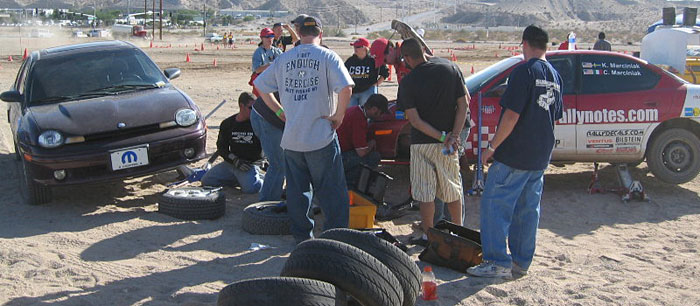
John Black’s Neon becomes a parts car for the rallynotes.com Rally Neon at the FRX Rallycross.
I can’t tell little parts of the story. I have to tell the whole story, so I’m working on it right now.
Yes, you read the scores correctly. We are the 2007 USRC Production Class Champions!
I’m encoding video and collecting pictures. Look for everything to trickle in soon!


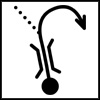 Blind Rally: Rallies in the US evolved a little differently then rally in Europe. Starting out as all night TSD’s (time speed distance) or brisk rallies, rally in the US did not typically run reconnaissance. This means that the rallymaster would give the co-driver a route book with major navigation instructions and some of the more extreme things to watch out for. Example: “BRIDGE – TURN RIGHT ON SNAPPY ROAD – CAUTION HAIRPIN” Next to this would be a little diagram (on right) showing the direction of the road or obstacle. Sometimes called ‘tulips’, the name is believed to come from the Tulip Rally of the Netherlands that originally used them.
 The Nintendo Generation: The internet allowed media and games from WRC and European rallies to flow into the US in the late 1990’s. I myself was following WRC long before I even knew there was an SCCA rally 100 miles from my home in New Hampshire. The images and ideas of rally – specifically the co-drivers rattling off hundreds of instructions while the daring drivers made heroic efforts to shave micro-seconds off their stage times – were forever burned into our brain. Anything less then this amazing driver and co-driver interaction wasn’t going to cut it. This may help to explain why competitors that have been competing in rally in the US for many years don’t understand why newer competitors demand stage notes and recce`. Remember the SCCA didn’t start using stage notes until 2002.


 The team started the 2007 Laughlin International Rally and Motorsports Festival last weekend with hopes of doing well in a regional class and to secure a runner up spot in the United States Rally Championship Production Two Wheel Drive Class. In an unbelievable twist with a rule in the 2007 USRC regulations the team was completely unaware of, the event was scored high enough so that they would have a shot at winning the championship.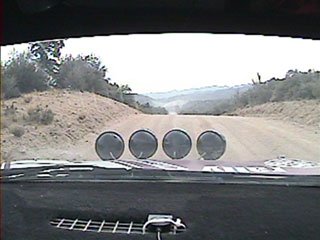
 .
.