| Frequently
Asked Questions
TrackerBox is a case containing several pieces of integrated
hardware for sending APRS (Automatic Position Reporting System) packet
data over 144.390Mhz. It was designed for use in rally cars, sweep vehicles,
and general stage rally use and abuse. The TrackerBox system itself
is NOT COMMERCIAL and you MUST have an amateur radio licence to purchase
and use it.
What is APRS and how
can it be used in stage rally?
APRS is used by amateur radio (ham radio) operators to track mobile
and fixed units via radio and GPS. Position information is fed from
inexpensive serial GPS antennas into a small chip computer (TNC) and
then transmitted over the airwaves on 144.390Mhz automatically. Please
check out wikipedia for more info.
ORLY?
What does that all mean??
Your car now has a box with a transceiver (radio that can transmit)
sending your exact location, direction, speed, altitude, callsign and
other information over the airwaves for anyone to pick up. The information
is sent in small (under 2 second) blurbs of data that sound like a modem
called packets. These should send out no more then once a minute.
Who can
pick up this data?
This data is sent all over the place by Digipeaters (Digital Repeaters)
They hear your APRS packets and re-transmit them at a higher power.
This allows your packet to be heard hundreds of miles away over mountains
and terrain.
A cheap radio scanner and a laptop with a sound card can receive these
packets and map their location without having to be ham licensed. (As
in, your service crew.) You also DON'T need to have an internet
connection if you can hear the packets directly over the radio or via
a digipeater. (As in, you are physically AT the rally.)

Here is what a typical rally APRS setup looks like.
Do I need and internet
connection?
Nope. Not if you're AT the rally and can receive packets from
a scanner into your sound card. You'll need a local map loaded on your
hard drive too.
What does it look like on my laptop?
There are several programs out there to map APRS data. One
of the current favorites is AGWTracker:
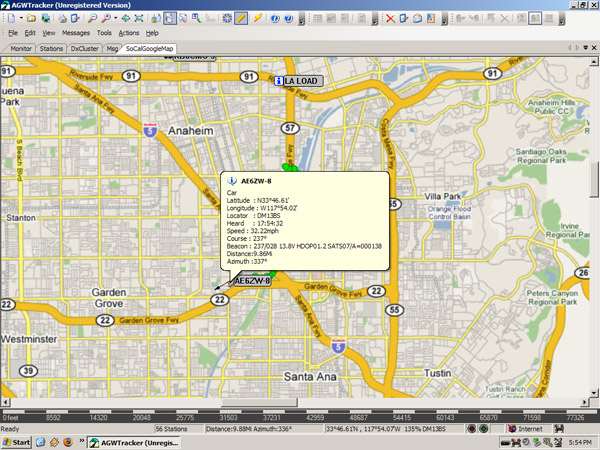
It provides a green track with dots when a packet is received. Mouse
over the dot and you get the direction, speed, etc. Maps can be made
in advance and loaded without having an internet connection. AGWTracker
can be found here.
How does that data get up onto the internet?
Remember those digipeaters? Well a lot of them are connected to the
internet. They take the packets they hear directly over the radio and
send them to a bunch of sites that map the data. This is really handy
if you want your parents in Portland Maine to watch you rally in Prescott
Arizona.
How can I track a callsign
that is sending APRS packets on the internet?
aprs.he.fi
findu.com
Pros:
* Everyone involved in the rally has the potential to know where your
vehicle is and if it's moving.
* Your crew will be able to follow the action in service instead of
wondering where you are or when you'll get there. Or at least have a
heads up when you get close (10 miles depending on terrain)
* Rallies are now setting up central APRS stations in service for everyone
to watch. (Avoiding 20 people having to bring scanners and laptops...)
* You have an emergency
radio in the car which you can pull out of the TrackerBox and use to
call for help on.
* One time cost vs. satellite trackers that can be up to $100 a day.
* You have received your Amateur Radio Licence and can now volunteer
when you're not competing. You can get one of the best spectator positions
in a rally - blocking a road on stage!
* When there is good digipeater coverage at the rally, your fans can
watch you on the internet.
Cons:
* No... It's not as good as WRC virtual spectator, but it beats not
knowing. The packet rate is slow. More then 1 minute between updates.
* Some rallies have bad
digipeater coverage and rough terrain. This means that not a lot of
packets will get to your crew and even less may get to them when you
are all the way in the middle of nowhere on stage. This can be relieved
if rallies set up temporary digipeaters. Rally New York is now doing
this.
So this is totally
free to use once I buy it?
Yes! Once you are licensed - and you purchase the equipment it is free
to use wherever and whenever
you want. Keeping in mind to always use good amateur radio practices
(Such as not setting the beacon rate below 1 minute.) Take
a look at all the APRS traffic in your area here.
How is this different
then those Spot Trackers?
Commercial trackers send and receive their location data to satellites
and private systems. It is a closed system - as in - not everyone can
get your location over a common frequency. Local volunteer hams will
not be able to receive this telemetry with basic equipment. They cost
anywhere from $50 - $100 a day to track your location. The data can
be uploaded and accessed through the internet - which is not always
available in service.
What makes up an Automatic
Position Reporting System?
The TrackerBox is just a box of component parts that work together
as a system. There are many different ways to implement APRS. It's a
radio that can transmit on 144.390 and a TNC that can get GPS data out
over the air. The TrackerBox is only just ONE way to set this up. Rich
Otis from Rally New York has a great 'Getting
started with APRS' page. There are also some radios that can send
and receive APRS data natively and allow you to talk to someone else
on a different frequency while doing it. Check
out the Kenwood D700.
Who came up with APRS? Want to get even MORE info?
Bob Bruninga, WB4APR - His website is at - http://eng.usna.navy.mil/~bruninga/aprs.html
What's an Anderson Powerpole?
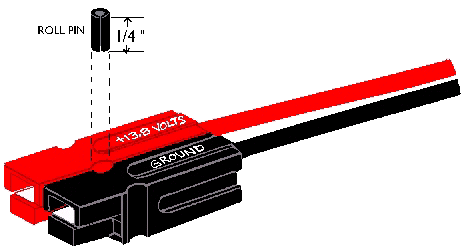
Simply a fantastic way to connect 12v electronics. The Anderson Powerpole
is a standard, highly reliable connector that allows quick and easy
installation and substitution of radios, power supplies, batteries,
and other equipment. There is no 'male' or 'female' gender to this connector.
Just position and wire up the connector as shown below and it will be
able to plug into any other wired powerpole connector. Many emergency
groups have adopted this connector as their standard. Check
out the many different options for the powerpole.
Final thoughts:
* APRS location info would be helpful in an emergency - but should not
be relied upon and will not be replacing communicators on stage.
* Fixed locations such as service and the hotel can be put on the map
for reference with helpful info such as meeting times.
* All APRS tactical planning should be referred to the Com Captain or
the Rally Organizers. Let them KNOW you're going to be running APRS
and what your callsign is.
* Rally drivers and co-drivers are becoming hams and need to be more
aware of the communications already going on at their local events.
* Ham radio operators volunteering for these events need to be more
aware of the fact that rally drivers and co-drivers have radios in their
cars.

|
